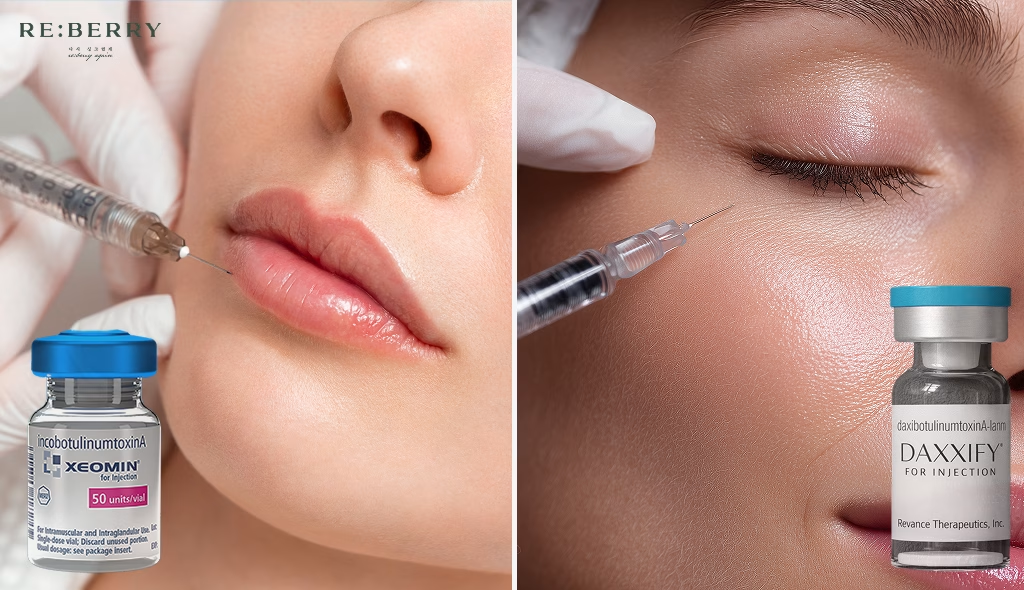
Suffering from persistent frown lines, crow’s feet, or those frustrating forehead wrinkles that seem to deepen with every expression? If so, you’ve likely heard about Botox and Daxxify as solutions for your problem, but wondering which one truly delivers better value for your time and money.
Both are injectable neuromodulators that temporarily relax wrinkle-causing muscles, smoothing dynamic lines for a refreshed look. Botox (onabotulinumtoxinA) has been the gold standard for smoothing dynamic wrinkles since its FDA approval for cosmetic use in 2002, temporarily relaxing facial muscles to soften existing lines and prevent new ones from forming. Daxxify (daxibotulinumtoxinA-lanm) is the newer option approved in 2022, and it works using the same active mechanism, the botulinum toxin type A, to help achieve similar results.
So how do Daxxify and Botox differ if they share the same active ingredient? The answer lies in their formulation and delivery systems. Daxxify incorporates a proprietary stabilizing peptide technology, which is designed to enhance the molecule’s longevity once injected. This innovation allows Daxxify to resist breakdown in the body for a longer period, which is why clinical studies show it can smooth wrinkles for an average of six months and sometimes up to nine, compared to Botox’s typical three to four months of results.
Keep reading to learn more about how these differences impact cost, treatment experience, and which option might align best with your aesthetic goals.
What is Daxxify?
Daxxify (daxibotulinumtoxinA-lanm) is the newest FDA-approved neurotoxin injectable on the market. It received its FDA approval in September 2022 for the treatment of moderate to severe glabellar lines, those vertical creases between the eyebrows that many patients call the “11s.” Developed by Revance Therapeutics, Daxxify works the same way as other neurotoxin injectables, i.e., it temporarily blocks the nerve signals that tell facial muscles to contract, which prevents the repetitive movements causing wrinkles to form and deepen over time.
Unlike all other neurotoxin injectables, Daxxify does not use human serum albumin as a stabilizing agent. Instead, it uses a proprietary synthetic peptide called Peptide Exchange Technology (PXT). This engineered peptide helps Daxxify bind more durably to nerve receptors, which is the primary reason its results last considerably longer.
What is Botox?
Botox is one of the most recognized cosmetic injectables in the world. Manufactured by Allergan, Botox was the first neurotoxin to receive FDA approval in 1989 for medical use, followed by cosmetic approval in 2002. Since then, it is renowned for non-surgical wrinkle reduction, with millions of treatments administered worldwide each year.
According to ASPS, Botox is the top minimally invasive treatment, and continues to grow year on year. What makes Botox different from newer alternatives is not its mechanism, but its track record. Over two decades of real-world use have given practitioners a depth of knowledge around dosing, placement, and technique across every facial area. It also uses human serum albumin as a stabilizing protein, a well-understood system refined over decades of clinical use. That accumulated expertise is what makes Botox results so consistently predictable.
Daxxify Vs Botox: How Are They Different
The main differences between Daxxify and Botox come down to their formulation, how long results last, which areas they treat, how much they cost, and where you can actually access them. Understanding each of these differences helps you make a decision that’s right for your skin and aesthetic goals.
Formulation
Both Daxxify and Botox contain botulinum toxin type A as their active ingredient. They work the same way, relaxing muscles by blocking nerve signals. The real difference is how each product is stabilized. Botox uses human serum albumin, a protein that’s been part of its formula for decades. Whereas Daxxify is completely different, using a proprietary synthetic peptide (PXT) that binds more durably to nerve receptors.
Ideal Skin Concerns
Both treatments are designed for dynamic wrinkles, the lines that form from repeated facial movements like frowning, squinting, or smiling. However, the treatment areas of Daxxify and Botox are different.
Daxxify is FDA-approved only for frown lines, but it can be used off-label elsewhere. Botox, on the other hand, covers more areas such as forehead lines, crow’s feet, frown lines, and neck bands. If you’re targeting multiple concerns in one session, Botox gives you more flexibility.
Treatment Frequency and Longevity
This is the most important difference between Botox and Daxxify. Botox typically lasts 3-4 months, meaning most patients return to the clinic 3 to 4 times a year for the treatment. However, Daxxify lasts 6-9 months as per the American Board of Cosmetic Surgery. That’s roughly half the number of appointments per year, as compared to Botox.
But the timeline is not guaranteed. Your metabolism, muscle strength, and dose of treatment all play a role in how long either treatment lasts.
Cost Per Treatment
Botox is generally priced at $10–$20 per unit, with a typical cosmetic session (treating the frown lines and forehead) using 20–40 units. Most patients spend $300–$600 per session, and with 3–4 sessions annually, the yearly cost can reach $1,200–$2,400.
Whereas Daxxify costs more per session, typically $600–$1,500 per treatment. However, you’re only booking 2 sessions per year rather than 3–4, the annual spend often works out to be comparable or even lower than Botox when calculated over 12 months.
Availability
Botox is available almost everywhere, from dermatology departments to aesthetic clinics. Its widespread availability, combined with 20+ years of practitioner training, means finding a skilled Botox injector is relatively easier in most major cities worldwide.
Daxxify is significantly less widely available. As a newer product, it is primarily offered at specialist aesthetic clinics and medical spas in the United States. It has more limited availability in other countries, particularly in Asia, where Botox alternatives from Korean manufacturers are more prevalent.
Is Daxxify Better than Botox?
Whether Daxxify is better than Botox really depends on what you’re looking for. If fewer appointments and long-lasting results are your priority, Daxxify is the best choice as its results can last up to 9 months. But if you want to treat multiple areas, prefer the flexibility of a shorter treatment cycle, or you’re new to neurotoxins entirely, Botox’s broader approvals and two decades of clinical data still make it a stronger option.
There’s one thing worth knowing before choosing Daxxify: because it lasts longer, any side effect that occurs will also take longer to resolve. A mild case of eyelid drooping that clears up in 2–3 weeks with Botox could take up to 6 weeks with Daxxify. That’s not a reason to avoid it, but it is a reason to start with Botox first if you’ve never had a neurotoxin treatment before. It gives you the chance to see how your body responds, and build confidence before committing to something longer-lasting.
Beyond that, availability and cost are other factors. Botox is widely accessible through experienced practitioners in South Korea and across Asia, while Daxxify simply isn’t available at most clinics in these regions yet. And if a lower cost per visit matters to you, Botox’s per-session pricing is considerably more manageable, even when the annual totals end up being similar. For patients who already know how their body responds to neurotoxins and want the convenience of fewer appointments, choose Daxxify. For everyone else, choose Botox.