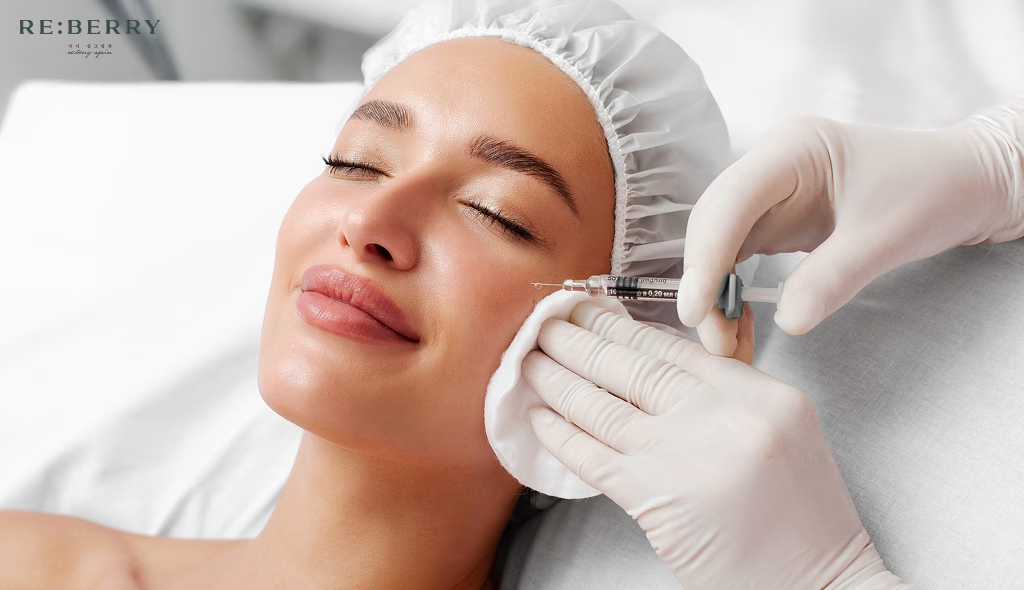
Facing skin that feels damaged, breaking out, staying red, or simply refusing to heal the way it used to? Or maybe you’ve noticed it getting thinner, more sensitive, reacting to products it once handled fine? If that sounds familiar, you’ve likely come across two names during your research: Exosome therapy and Rejuran.
Both of these treatments promise regenerated, healthier skin and are popular in Korean clinics. These treatments work through completely different mechanisms. Rejuran rebuilds your skin’s foundation gradually, whereas exosomes send regenerative signals to cells that have stopped working as they should. Choosing the wrong one for your skin type won’t necessarily cause harm, but it will cost you results you could have had.
In this blog, we’ll break down the key differences between Exosome and Rejuran, how they differ across mechanism, downtime, results, cost, and how to decide which treatment you should choose for your skin.
What Is Rejuran?
Rejuran is a polynucleotide (PN) skin booster derived from highly purified salmon DNA. It has been one of the most trusted regenerative treatments in Korean dermatology for years. In fact, a survey of Korean dermatologists published in the Journal of Cosmetic Dermatology found that injectable PN was their top-ranked skin booster, overtaking small-particle hyaluronic acid in clinical preference.
When Rejuran is injected into the dermis, its PN fragments get to work at a cellular level. They stimulate fibroblast activity, which drives new collagen and elastin production. This supports your skin’s natural repair mechanisms, improves hydration retention, and helps restore a compromised skin barrier.
Clinical studies show promising results; in a trial involving 27 participants, the Rejuran-treated side showed significantly higher aesthetic improvement scores and a 61.4% reduction in periorbital wrinkles after 12 weeks, with adverse events limited to minor swelling and bruising according to MDPI Applied Sciences.
However, Rejuran isn’t a one-size-fits-all treatment; it actually comes in several formulations tailored to different skin concerns. The classic Rejuran Healer is designed for overall skin rejuvenation across the full face. If your focus is the delicate eye area, Rejuran I is specifically made to treat fine lines and thin under-eye skin. For deeper acne scars and uneven texture, Rejuran S uses a thicker formula to target indented areas more effectively. Whereas, Rejuran HB Plus includes lidocaine to make the treatment more comfortable.
What Is Exosome?
Exosomes are a newer, next-generation regenerative treatment, and in Korea’s aesthetic medicine landscape, they have quickly become one of the most talked-about skin boosters in recent years.
Exosomes are nanosized extracellular vesicles (typically 30-150 nm) secreted by stem cells. They’re not cells themselves; they are more like biological messengers. Each exosome carries a payload of growth factors, proteins, microRNA, and cytokines that instruct surrounding skin cells to regenerate, calm inflammation, and produce collagen. Research published in PubMed found that exosomes play a central role in intercellular communication and have shown meaningful results in skin repair and anti-aging applications.
In practice, exosomes are delivered through microneedling (MTS) or mesotherapy. Some clinics apply them topically after laser treatment to accelerate post-procedure healing. Because the delivery method avoids deep injections in the way Rejuran requires, the procedure is generally gentler, and recovery is faster. Exosomes are particularly effective for inflammation, pigmentation, acne-related damage, and dull or uneven skin tone.
Exosome Vs Rejuran: What’s the Difference?
Both Exosome and Rejuran treatments are often recommended for similar skin concerns, which can make choosing between them confusing. However, each works in a different way and is designed to target specific skin needs. Understanding how these treatments differ will help you select the option that aligns best with your skin goals and concerns.
Active Ingredient
Polynucleotides (PN) from salmon DNA
Stem cell-derived extracellular vesicles
Primary action
Skin repair and barrier strengthening
Cellular signaling and regeneration
Thin, damaged, or aging skin
Inflammation, pigmentation, and post-treatment recovery
Delivery method
Microinjections into the dermis
Microneedling, mesotherapy, or topical post-laser
1 to 3 days (mild bumps, redness)
Minimal, usually 24 to 48 hours
Results timeline
Glow from week 2; builds over 2 to 3 months
Brightness visible within 1 to 2 weeks